21 March 2025, Geography Labs, University of Manchester

Session 1: Moss and Peat
In the morning session, Emma Shuttleworth will talk us through the environmental processes through which mosses form peat and the techniques through which scientists are able use mosses as windows onto past, present, and future environments. We will look at how, through the formation of peatlands, mosses can act as records of past environments, and how scientists ‘read’ these records in the field and in the laboratory. We will also consider how mosses act as ecosystem engineers, regulating flows of water and climate conditions at various scales, and thereby have the potential to play a central role in both regional flood control and in achieving national and global net zero goals.
Session 2: Moss Stitch
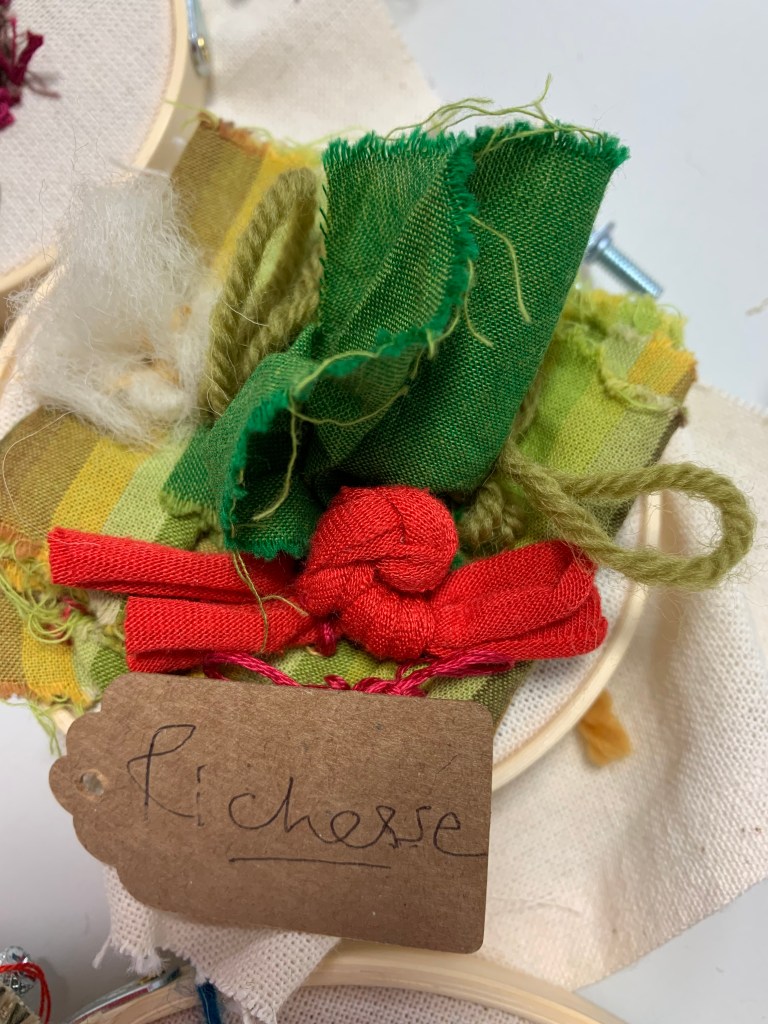
In this session, hosted by Natalie Linney and Laura Pottinger at the Geography Laboratories, we will explore creative and tactile ways of getting to know mosses on more intimate terms. Focusing on sphagnum moss and its aesthetic qualities, we will consider together how creative methods could facilitate a closer understanding of mosses. The session involves handling and looking closely at sphagnum moss; exploring it as a source of colour; and recreating it at a range of scales through stitch. Natalie will share the results of her experiments in creating pigment from sphagnum moss. All workshop participants will be invited to create a stitched piece which will form part of an exhibition at the Moss Worlds final event at The Firs. We will also share details of a proposed creative publication for cultural geographies reflecting on the Moss Stitch workshop in which all participants will be invited to contribute as coauthors.
Reflections by Laura Pottinger
Workshop 3: Stitching sphagnum moss
How might we get to know moss on more intimate terms? And what methods can help bring together the varied disciplinary knowledges, embodied dispositions and forms of attentiveness needed to appreciate mosses – plants that are small and slow growing, and which, historically, have been overlooked and understudied?
In March 2025, we held a creative stitching workshop in the University of Manchester’s SEED (school of Environment, Education and Development) Laboratories. The ‘Moss Stitch’ workshop, led by Natalie Linney and Laura Pottinger invited participants to get to know (sphagnum) moss more intimately by stitching it. This task required focused attention and tactile engagement with mosses and materials, opening a space for knowing mosses otherwise.
A recent paper in cultural geographies coauthored by the MossWorlds team outlines how creative stitching could be a method for facilitating interdisciplinary collaboration. We ask how stitching could encourage slowly paced, tactile ways of noticing and getting to know plants – in this case, sphagnum mosses. Drawing together reflections from ‘Moss Stitch’ workshop participants we consider what it means to carry out creative, cultural geographic practice in geography laboratories – spaces traditionally reserved for physical geographers and the ‘hard’ environmental sciences. We ask how performing soft forms of textile making might subvert these spaces and norms.
Link to journal article:https://journals.sagepub.com/doi/10.1177/14744740251358283
Creative interdisciplinary geographies in practice: Stitching sphagnum moss – Laura Pottinger, Anke Bernau, Abigail Bleach, Amanda Cobbett, Khushi Dodhia, Abbi Flint, Aurora Fredriksen, Antony Hall, Ingrid Hanson, Oliver TW Hughes, Sophy King, Natalie Linney, D Henry James McPherson, Kayley Pearson, Joseph Pickard, Jonathan Ritson, Emma Shuttleworth, Arianna Tozzi, Rachel E Webster, 2025
 MossWorlds